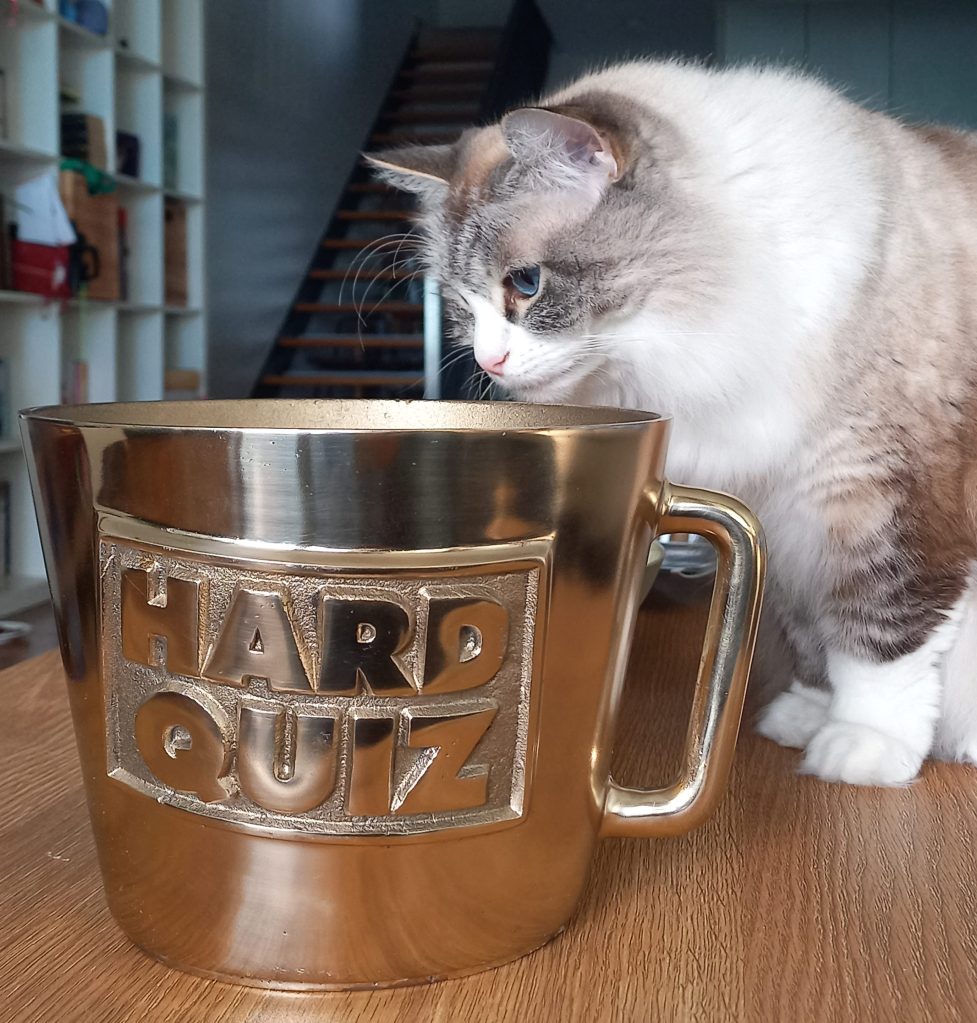
It has been more than two years now since my episode of Hard Quiz aired, and more than three since I filmed it. I think it is fair to say that “spoilers” no longer apply and I can finally gloat about my win.
While I haven’t yet rocketed to a state of household recognition, it was a wonderful experience that I still look back upon fondly, and which has been a somewhat constant source of delight to the new people that I meet when they see the mug.

Beyond this though, I think there has been some symbolic or at the very least coincidental association that I can still draw from the whole thing. My choice of topic, Che Guevara, is something that in some ways was accidental; I had originally signed up to do The Room which didn’t pan out due to the pandemic and was later poached by someone else. Why, I mainly chose Che Guevara because the Argentine that I am far more obsessed with, Julio Cortázar, would be far too niche for Australian audiences to find interesting.
Of course, to confess this is not say that I am not also keenly interested in Che Guevara. He is a figure that has reappeared in my life over many distinct phases and has embodied and represented them in ways that I am still trying to deconstruct.
Firstly as a secondary school student with a keen interest in 20th century history, and in particular the spread of communism, the Cuban revolution, and its most emblematic, representative figure in Che, proved fruitful for my independent study. While I can’t claim it radicalised me, it certainly confirmed many of my suspicions about the world. Learning that he was a bookish asthmatic before he was a romantic, militant figure certainly allowed me to sympathise with him even further as it is something that we share. Watching and reading excerpts from “Diarios de Motocicleta” in my Spanish class with one of my favourite teachers certainly didn’t hurt either.
Later in University, Che came to represent my developing reconnection to my Argentine roots and my desire to improve my Spanish fluency. Che returned as an object study in a course into Modern Latin America that effectively represented the capstone course in my Minor qualification of Spanish and Latin American studies, a Minor specialisation that I only really enrolled into accidentally because there was a timetable clash between the History course I originally wanted to take and a Creative Writing elective. My only option was to take on Spanish. This minor decision in the first week of a four-year degree unknowingly locked me into staying the course, particularly given that my existing linguistic proficiency forced me into the Advanced course. A further coincidence was that the University was undergoing somewhat of a cull of the discipline, one that I believe it has now been completed, which left me with very limited options for courses to choose. Thankfully, the Modern Latin America course was one of the best I studied, and opened my eyes to the multidisciplinarity that the study of Latin America as an academic object represents. Never had I seen my interests in Literature, History, Culture, Philosophy, Politics and even Economics so synthesised in a single program. Without that course, I would never have even been introduced to Julio Cortázar in the first place.
That same year, by coincidence or providence, my wife and I were travelling to Córdoba in Argentina and found ourselves in a conversation with an exceedingly generous Museum attendant, who told us that not only 40-minutes away by bus, lay the town of Alta Gracia, which to our great surprise housed the Casa Museo del Che, given it was where he was born and raised due to his aforementioned Asthma. In fact, that little city was home to a whole series of famous Argentines and even Spaniards such as Manuel de Falla that had chosen to emigrate for the clean alpine air that allegedly did much to aleviate the symptoms. It was there that we bought the shirt that I wore on the show, and learnt one of the fun facts that would in fact be used to test me at the climax of the show. I didn’t get it right, but I still saw the room in the museum flash before my eyes. On that same trip I bought all sorts of CDs and books that I would later find out had surprising connections to my later study of Latin America, such as Los Brujos, Horacio Quiroga and Don Segundo Sombra, and even visited art galleries and displays that I would only really understand the significance of later.
And this brings me to the final phase of Che, at least up to this point. You see, after returning to Australia that time, I became even more convinced of the importance of my Argentine culture to my sense of identity. Having felt much of a fraud for most of life, that trip confirmed for me how much I belonged, culturally, spiritually, ethically to the region, even if my tongue sometimes betrayed me. I decided almost then and there that I would take on an extra year of study to complete an Honours degree in Latin American literature. I spent weeks reading and rereading many of the classics, García Márquez, Borges, and even Allende, whose House of the Spirits I had nabbed from a clearance at the High School where I completed my teaching placement, oscillating over which I most wanted to write about. That is, of course, until I was reminded of a certain Argentine writer whose name had popped up in a course I studied by that point almost two years previously.
Julio Cortázar’s short stories instantly captivated me. I found in his prose, a voice, a feeling, that made me feel seen and understood, truly understood for perhaps the first time. I was camping with my wife and couldn’t put it down. On the drive back I just about summarised every single one, unable to contain my confusion as to how it was I could have made it those Twenty-Two years without having heard of him before. Without that thought, there wouldn’t really have been an Honours, nor my Doctorate. To learn, he too was a committed socialist, and that it cost him dearly; that he too lived abroad for a complex mix of reasons equally economic, political and aesthetic, a sort of self-imposed exile that I too felt in choosing to commit my life to Australia; to realise that he was facetiously referred to as the”Che Guevara of literature,” and most importantly to find out that it was his very same translator, upon his recommendation, that led to the translation of One Hundred Years of Solitude.
What any of this has to do with Che or Hard Quiz? Your guess is as good as mine.
I suppose, having now come back from a conference where I heard both Che and Cortázar maligned as “the machistas of the Left,” I have come to think about what my interest in these men and this history say about me, and perhaps even what that has meant for me.
I certainly believe that going on to represent Che Guevara on Hard Quiz was only really possible because I have a vaguely Che look about me. It’s maybe even this same look, or at the least my political leanings, that have resulted in my being undervalued across a range of different academic and professional settings over the years.
In any case, in my own petit bourgeois manner, I hope that I am able to continue living up to the legacy of my asthmatic antecedents, even if I already have the mug to prove it.