Originally published under the title of “Somnolence” in Unsweetened 2018, Arc, UNSW. Accessible online at: https://issuu.com/arcunsw/docs/unsweetened-2018
I do not dream. That is to say, I suppose, that I do not remember my dreams when I recover myself in the morning. We all dream. I see that now. Really it was arrogant to think otherwise. It’s funny how we define ourselves by what we don’t have, by our absences, like how a widow or a widower is. It was so important to me to set myself apart, to label myself the other; a person who does not dream. It made me special. I even convinced myself that it was true and that every fleeting feeling of agony that I had experienced before opening my eyes in the morning was nothing, not a memory, not a dream. But I can’t pretend any longer. I’m not coping. The dreams don’t fade away like they used to. They stay with me, nipping and gnashing at my temples at all hours of the day. Even now as I speak with you. It’s like déjà vu, seeing those same torturous images superimposed onto every landscape.
I find that recounting even one fragment of the infinite anthology that has presented itself to me is an exercise in implausibility. I know that I can never capture those nightmares in their totality, no matter how many times I experience them. I’m sure that someone in your position can attest to that. All the same, I don’t think that it will stop you. Because that’s why I’m here isn’t it? So that you can draw out a constant element, some twisted thread of reason from my inaccurate accounts. I’ll indulge you. All I want is to rest, to sleep like I used to, at the very least so I can be certain when I am dreaming again.
I can see that you are surprised. Surprised that there could be something more pressing to me than the matter at hand, that which you have been informed of by the nurses. Your impenetrable glasses give you away. The image of your fingers twitching at the keyboard is reflected in them. Surely you can understand how it is that these two situations are related? That must be what you are typing; that I’m consumed by my grief, delirious and delusional. If that’s what you believe then please, indulge me too. You can only aspire to assist me with my grief if you can find out where it really lies; and it is here, in this immaculate office of yours, haunted by that lingering presence.
It all starts when I find myself trapped in the bathroom. The white door is sealed tight behind me, just like in this office. It’s a claustrophic space. I cannot move a muscle. The handle is easily in reach, not that I can see it clearly; I’m facing the wrong way. What lies in front of me is the mirror and wash basin. My reflection stares back at me, obscured by a cloudy film, ashen in appearance. I mechanically run my hands through the stream of inky water flowing out from the tap and bring them up to my face, blinking like a mad man. The foggy apparition is drawn further into focus every time that I lift up my heavy head. A sense of horror inexplicably dawns on me as the shapes pop out from the silhouette. I want nothing more than to keep staring at my hands, but I am powerless to resist the creaking of my straightening neck.
I see myself clearly for the first time. I am old, with all those vital colours drained from my face, as if I were frozen in time like a daguerreotype. Somewhere along the way, my hair had become the frayed filaments of a split cable and my eyes welts, lost in a valley of wrinkles and stained with tracts of parched tears that evaporate like dust. I try to scream, and am confronted by the sight of empty gums and my writhing worm of a tongue behind strands of spittle that link my lips.
Look at me doctor and be honest, can you see what appears when I furrow my eyebrows? A gash; a cracked fissure in my lid. I see the truth every time that I gaze upon that incessant wrinkle. I am nothing more than a rotting chunk of meat, running on borrowed time. I first fell into that chasm in Dunedin. I am holding my father’s hand with devoted trust. The sound of sea lions barking drifts on the bitter Antarctic wind. “Wohwoh’s,” I call out, my tiny hand pointing to the bay. My father is beside me wearing his fur-lined leather jacket and nineties blue jeans, laughing. I look up at his youthful face. His features eclipse the rays of the southern sun.
All at once the idyllic scene is fractured by the first tremors from the earthquake exhibit in Te Papa, eight hundred kilometres away in Wellington. The shaking house bleeds through the splintering street; lampposts curling, cars swerving, a television crashing onto a lacquered floor. My arm is wrenched from its socket when I am swallowed by the abyss. Dad is clutching my limp wrist with Herculean resolve. His contorted expression of guilt is the last thing that I see before the sleeve of my red parka explodes in a cascade of cotton fibres. His desperate scream, a name that I no longer recognise, echoes in the void as I plummet to the centre of the earth, into the very furnace from where Prometheus first stole the spark of stardust that animates my bones. It occurs to me, because of a nagging sensation in my bowels, that I am not really falling, but rather, traversing the limitless axes of space at the speed of light; loitering in the cosmic waiting room, that lobby of damaged light that presents itself to me every time that I scrunch my fists into my closed pupils. The sheer terror of having lost a loved one forever suddenly feels inconsequential and gives way to understanding.
But why then, do I wake? All traces of the divine connection are severed and my mattress indented by the sudden impact of my arrival back on the bed. New life rouses my corpse, making my mouth snap open and my chest inflate with stale air. “What’s the matter?” she protests, the sound of sand sprinkled in her speech. “Nothing darling,” I reply, unable to articulate a recollection of that sensation. I turn to face her and run my fingers through her hair, an action that has always been able to quell any restless listlessness. I continue the motion in time with the rhythm of her satiated purring. I slowly notice stragglers separating and wrapping themselves around my fingers, as if my palm were charged with static. I call her name out, a queer inflection in my voice, a delicate mitten smothering my fist, to sudden silence. I fumble for the lamp. Countless books and glasses of water clatter to the floor and I can’t press the button with my digits ensnared. I hear a guttural growl besides me, and leap out from the sheets, to the wall opposite and flick the switch for the overhead light.
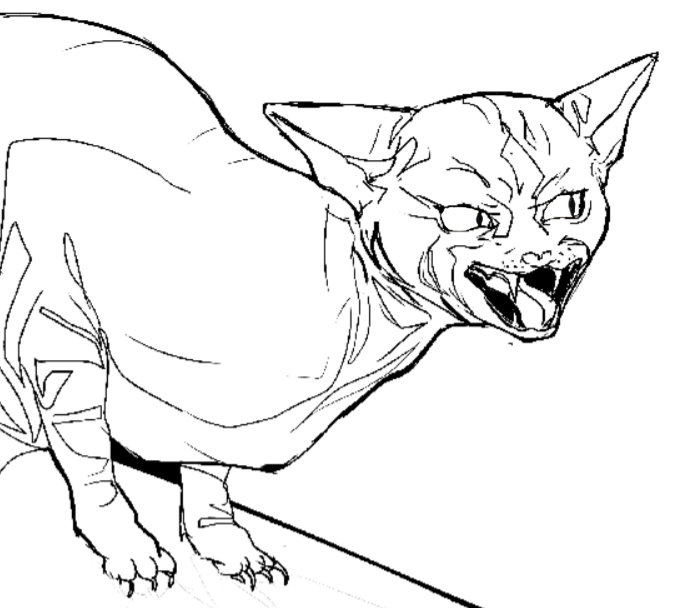
Perched on her pillow, is a sphynx cat with celeste eyes, burning cold with resentment. Its claws extend into the bleached fabric and darn red threads into the canvas. “What have you done?” I plead, aware of a cunning intelligence lurking behind those profound blue buttons. With a flick of its naked tail, it leaps across the divide, sailing past the patterned alpaca wool rug that we had transported all the way from Peru, a feminine screech trapped in its cavernous, pink gullet. I cushion its bites with the golden gloves made from its fallen fur, and force it to the floor. I bludgeon its fragile body with primordial ferocity. Its ribs and skull rupture; its choked agony splutters out in crimson rivulets that spell out another forgotten name. As I stand over the discarded doll, its cotton stuffing spilt out across the carpet, I am moved by an inexplicable sense of loss. I linger a moment before returning to the empty bed.
I close my eyes out of habit, aware that the worst is still to come. I can see it now. A mother, distended and skeletal, looks out to the glimmering ocean on the other side of the plate-glass window. She is supported by a technological contraption that I can’t understand. Wires protrude from and penetrate her arms and breast, blood and fluids circulating until I am forced to look away. Her daughter, too young to comprehend, sits by her side, gazing upon her face, puffed raw by her damp sobs. I am powerless to console her. I am doing all I can to possess a lone kite in the sky so I can be transported along the warm currents to those days of southern sun.
I am wrenched back from my thoughts, weeping at the side of an alabaster statue. The girl and her stuffed monkey are led out of the room by a white coat. A woman in a navy uniform explains to me that it was a peaceful process, and offers her shoulder to me for support. She leads me down winding corridors, past rows of identical, mechanical chairs filled with matching models with painted-on eyebrows and their families’ expressions of resolve in front of gaping glass walls that reveal the bustling streets below on this beautiful day. I am told that Dr. Pentos is well equipped for dealing with such matters. I should do my best to describe exactly how it is that I am feeling. “It will help,” she insists, sitting me outside an imposing cream door, beneath a blaring, ultra-violet light, and holding my hand as I compose myself. At last, the door swings open as if animated by a great magnet, and I see him, the good psychologist, inviting me into his immaculate office with his impenetrable glasses.